This article contains affiliate links.
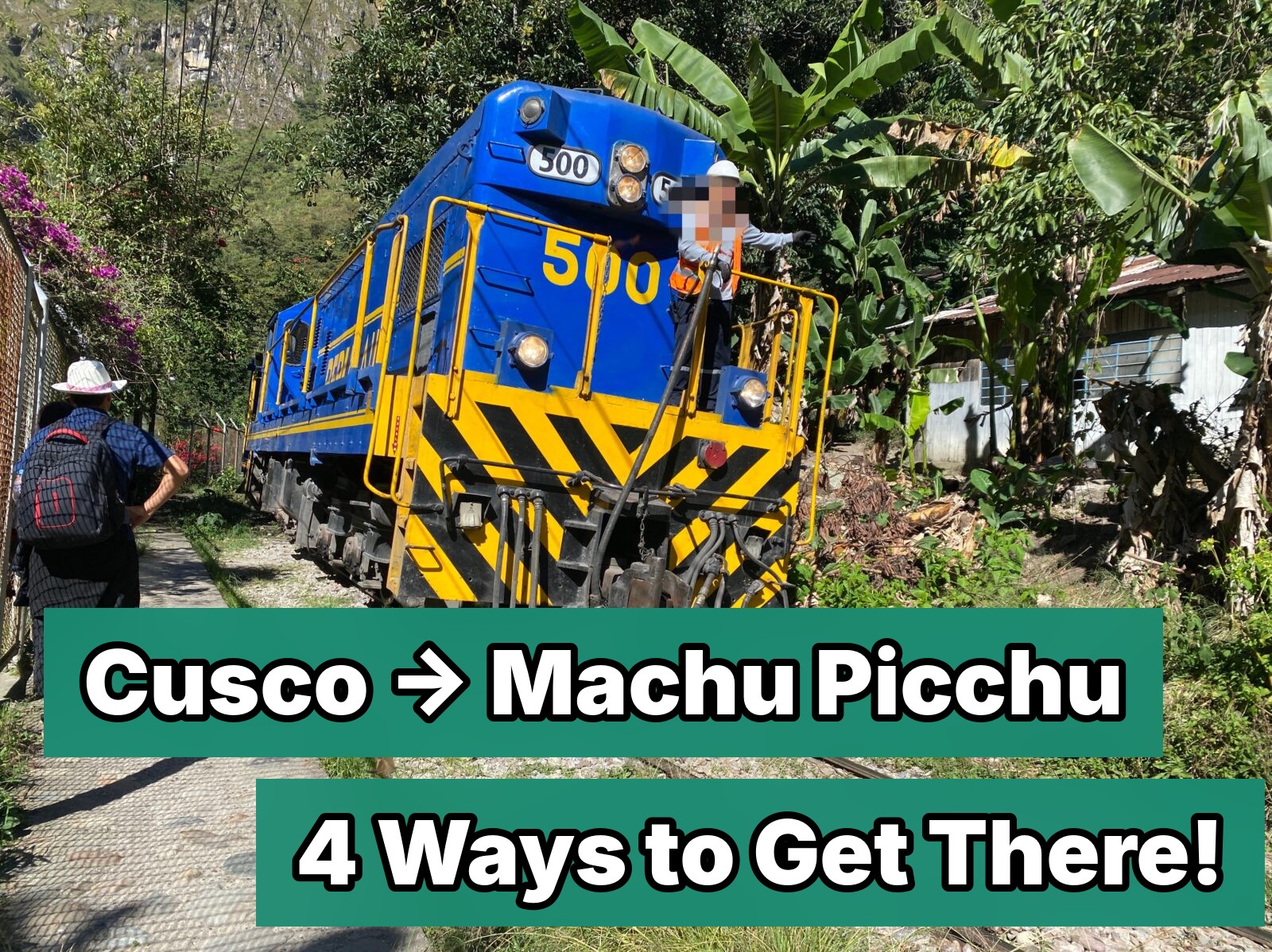
Getting to Machu Picchu is a little more complicated than most people expect. The ruins sit high in the mountains, there’s no road all the way in, and there are several different ways to make the trip.
We visited in June 2024 as part of our round-the-world trip. In this guide we’ll walk through every way to get from Cusco to Machu Picchu, and tell you which route is the fastest and which is the cheapest — plus what the budget “Stand By Me” trek along the railway tracks is actually like.
Prices were checked in June 2024 (USD 1 ≈ PEN 3.8). Fares change often, so double-check before you book.
1. The Three Legs of the Journey
Whichever route you choose, you’ll go through these three steps:
- Fly to Cusco (usually via Lima)
- Travel from Cusco to Aguas Calientes (also called Machu Picchu Pueblo)
- Go up from Aguas Calientes to the Machu Picchu ruins
1-1. Getting to Cusco
The closest airport to Machu Picchu is Cusco International Airport (Alejandro Velasco Astete). Most international travelers fly into Lima first and take a short domestic flight (about 1.5 hours) to Cusco.
Cusco sits at about 3,400 m (11,150 ft), so plan at least a day or two there to acclimatize before heading on to Machu Picchu.
1-2. Cusco to Aguas Calientes (Machu Picchu Town)
From Cusco, you head to Aguas Calientes, the small town at the foot of Machu Picchu that serves as the base for visiting the ruins.
This is the part with the most options — and the most confusion. Broadly, there are four ways to do it:
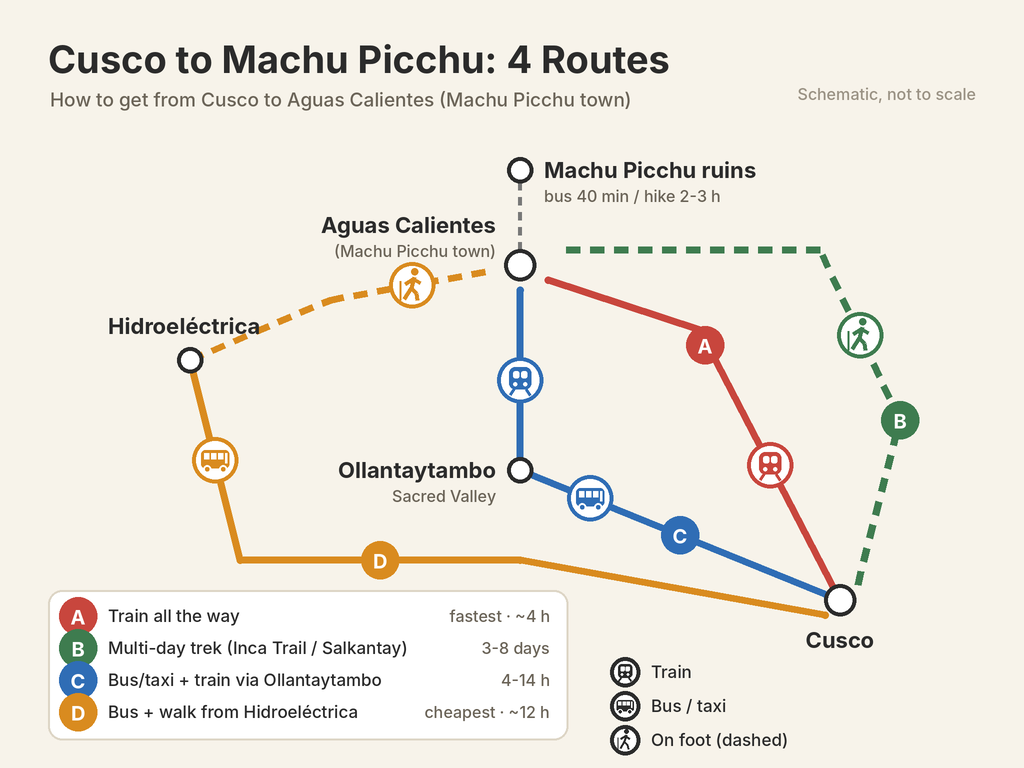
- Route A: Train all the way from Cusco to Aguas Calientes
- Route B: Trek from Cusco to Aguas Calientes (Inca Trail / Salkantay Trek)
- Route C: Bus or taxi to Ollantaytambo + train to Aguas Calientes
- Route D: Bus to Hidroeléctrica + walk to Aguas Calientes
Route A: Train All the Way

Route A is a single train from the Cusco area straight to Aguas Calientes. It’s the most comfortable and the fastest option — but also one of the more expensive ones.
Two companies run trains to Machu Picchu, PeruRail and Inca Rail, but only PeruRail runs trains departing from Cusco. You can book on the official site:
PeruRail (official site): https://www.perurail.com/destinations/machu-picchu/
Price: from about USD 70
Travel time: about 4 hours
Route B: Trek the Whole Way
Route B means walking from the Cusco region to Aguas Calientes over several days. It takes the most time and costs the most, but it’s the best way to experience the mountains and Inca ruins between Cusco and Machu Picchu. There are two main treks:
i. The Inca Trail
The classic Inca Trail comes in a short 2-day version and the famous 4-day version. Either way, you can only do it with a licensed tour — independent hiking isn’t allowed.
The 4-day trek is hugely popular and is often booked out months in advance.
Tip: Most Inca Trail tours finish with a guided visit to Machu Picchu on the last day, and the entrance ticket is often included. Check before you buy a separate ticket so you don’t pay twice!
Booking directly with a local agency in Cusco is usually cheaper, but it’s hard to arrange from abroad unless you’re comfortable negotiating over WhatsApp. If you’d rather book online, GetYourGuide lets you compare itineraries and read reviews first. We’ve used it for several other tours on our trip and found it much easier to check exactly what’s included.
2-day Inca Trail
4-day Inca Trail
ii. The Salkantay Trek
The Salkantay Trek is more flexible, ranging from about 3 to 8 days, and you don’t have to join a tour — you can do it on your own.
Where the Inca Trail links together a string of ruins, the Salkantay Trek is all about dramatic high-mountain scenery. Tours are listed on GetYourGuide too, but if you have a few spare days in Cusco, local agencies are usually cheaper. Even if you plan to go independently, a tour can work out cheaper than renting all your own camping gear.
Price:
Inca Trail: about EUR 300–750
Salkantay Trek: about EUR 350–600
(Varies a lot by length and what’s included — treat these as rough figures.)
Duration: 3 to 8 days
Route C: Bus/Taxi to Ollantaytambo + Train

Route C takes you from Cusco to Ollantaytambo by bus or taxi, then by train from Ollantaytambo to Aguas Calientes.
Why split the trip? Because the Sacred Valley around Ollantaytambo is packed with sights of its own — Ollantaytambo’s fortress, the Maras salt pans, the Moray terraces, Pisac and Chinchero. Ollantaytambo itself is a charming town with plenty of hotels, restaurants and cafés, and many travelers spend a night there on the way.
Step 1: Cusco → Ollantaytambo
There are three ways to cover this leg:
Colectivo (shared van): The cheapest option. Colectivos are local shared minivans, so you’ll be riding with residents — easy if you speak some Spanish, a bit more of an adventure if you don’t. They leave only when full, and they only go to Ollantaytambo, so you’ll need a taxi or tour to visit Maras, Moray, Pisac or Chinchero. Best if you have time to spare and only want to see Ollantaytambo itself. Colectivos leave from the stop for Urubamba and Ollantaytambo on Calle Pavitos in Cusco.
Tour bus: The easiest option for most visitors. You can book through a local agency, your hotel, or GetYourGuide. Sacred Valley tours usually stop at several ruins on the way — just check exactly which sites are included, as some get cut for time.
Taxi: The big advantage here is that you can build your own itinerary around the Sacred Valley sites. We hired a taxi from Ollantaytambo to Maras and Moray and back for PEN 120 (about USD 32) plus a tip. Our guess is that a full day from Cusco covering Maras, Moray, Pisac and Chinchero would come to around PEN 200–300 (USD 53–80). For a group of three or more, that can work out cheaper than a tour.
Step 2: Ollantaytambo → Aguas Calientes by train
Both rail companies run this section. You can book here:
PeruRail / Inca Rail
We took Inca Rail in the opposite direction on our way back — see our Inca Rail experience below.
Price:
Colectivo: about PEN 10–20 (USD 3–5)
Tour bus: about PEN 100–200 (USD 26–53)
Taxi: about PEN 150–300 (USD 40–80)
Train: from about USD 58
Travel time:
Colectivo: about 2 hours (plus waiting time)
Tour bus: about 8–12 hours (with sightseeing)
Taxi: about 2–12 hours (depending on stops)
Train: about 1.5 hours
Route D: Bus to Hidroeléctrica + Walk (the “Stand By Me” Route)

Route D takes you by bus from Cusco to Hidroeléctrica, then you walk the rest of the way to Aguas Calientes. (Hidroeléctrica is Spanish for “hydroelectric plant,” which is exactly what’s there.)
It’s a surprisingly popular choice for travelers with a bit of time. It’s the cheapest route by far, and the walk follows a working railway line through the jungle — including an iron bridge straight out of the movie Stand By Me, which is why some travelers call it the “Stand By Me route.”
You can book the Cusco–Hidroeléctrica bus through a local agency, your hotel, or GetYourGuide. We booked the one below on GetYourGuide for EUR 23.28. Out of curiosity we checked a local agency in Cusco later, and it was PEN 60 (about USD 16). The difference is under USD 10, so if you have time to shop around in Cusco, go local; if you’d rather have it sorted before you arrive, GetYourGuide is the stress-free option.
For what the walk is actually like, jump to our Hidroeléctrica trek below.
1-3. Aguas Calientes to the Machu Picchu Ruins

From Aguas Calientes, there are two ways up to the ruins: the Consettur shuttle bus or hiking up.
We strongly recommend the bus. Walking is free, but it’s 2–3 hours of steep uphill climbing at altitude, and the last thing you want is to feel sick before you’ve even seen the ruins. This is one place where it’s worth spending the money. The Consettur ticket office is right by the bus stop in the center of town.
Price: USD 12 one way
Travel time: about 40 minutes
2. Which Route Is Fastest? Which Is Cheapest?
Short answer: Route A (direct train) is the fastest, and Route D (bus + walk from Hidroeléctrica) is the cheapest.
| Route | Time | Approx. cost |
|---|---|---|
| A: Train only | About 4 hours | PEN 266 (≈ USD 70) |
| B: Multi-day trek | 3–8 days | PEN 1,200–3,000 (≈ USD 315–790) |
| C: Bus/taxi + train | 4–14 hours | PEN 230–520 (≈ USD 60–137) |
| D: Bus + walk | About 12 hours | PEN 60–93 (≈ USD 16–24) |
Each route has its own appeal, though. Here’s how we’d choose:
- Short on time → Route A (train only)
- Love hiking → Route B (Inca Trail or Salkantay)
- Want to explore the Sacred Valley too → Route C (bus/taxi + train)
- On a tight budget, or want a light trek → Route D (bus + walk)
3. What Inca Rail Is Like

On the way back, we took Inca Rail from Aguas Calientes to Ollantaytambo in the cheapest class, The Voyager. Here’s what to expect.
3-1. Aguas Calientes Station

The station is new and clean, with a garden, a small café and a waiting area, so there’s plenty of space to kill time. Staff check tickets at the gated entrance, so it feels safe, and it’s just a short walk from the town center. PeruRail and Inca Rail both use the same station.
3-2. On Board

Even in the budget Voyager class, the carriage was modern and spotless. Every seat has a fold-down table for snacks or a bit of work, and the windows are huge — the whole carriage is designed for taking in the views.

There was no Wi-Fi or power outlet, but the ride only takes about 1 hour 40 minutes, so it wasn’t a problem. There’s an on-board toilet.
3-3. Things to Know Before Taking the Train
1. No large luggage. Neither PeruRail nor Inca Rail has luggage racks for big bags — your bag goes under your seat. There are also weight limits: 5 kg on PeruRail and 8 kg on Inca Rail. Leave your suitcase or big backpack at your Cusco hotel and bring just a daypack. Most hotels in Cusco offer free luggage storage, so ask when you book.
2. It’s bumpier than you’d think. The line winds through the mountains, and the carriage sways quite a bit. I get motion sick easily and felt a little queasy, so bring motion sickness tablets if you’re prone to it.
4. The Hidroeléctrica Trek: Our Experience
On the way to Machu Picchu, we took Route D: bus from Cusco to Hidroeléctrica, then the walk to Aguas Calientes. Here’s how the day went.
4-1. Pickup in Cusco
After booking on GetYourGuide, the local tour company contacted us to ask where we were staying. On the day, the van picked us up at our hotel around 6:20 a.m., collected the other passengers, and headed for Ollantaytambo. The road twists and turns a lot — I got thoroughly carsick.
4-2. Breakfast Stop

A little after 8:00 a.m. we stopped at a cafeteria near Ollantaytambo for a 30-minute break. A breakfast set was PEN 20 and a fruit salad PEN 15.

Use the toilet here — there’s only one more bathroom stop in the next five hours of driving. Bring your own toilet paper.
4-3. Arriving at Hidroeléctrica
We reached Hidroeléctrica around 1:00 p.m. The van dropped us at a restaurant just past the start of the trail.

Not sure whether we’d find food further on, we paid PEN 20 for a burger there — steep for Peru. But here’s the thing we really want you to know: once you’re on the trail and reach the tracks, there are lots of small local eateries, where a burger costs about PEN 5. If you’re on a budget, wait and eat there!

4-4. The Walk
Most of the trek follows the railway on flat ground. We started walking around 2:00 p.m. and arrived in Aguas Calientes around 4:40 p.m. — about 2 hours 40 minutes in total, including a 20-minute break.
① The trailhead. Before you start, you’ll register your name and nationality at a checkpoint (I think they checked passports too, so keep yours handy).

② Hidroeléctrica station. About five minutes in, you reach the station, lined with shops and cafés where you can eat or take a break. Many cafés will let you use their toilet for about PEN 2 — do it here, as there’s nothing for a while after the station. Shortly after, a set of stairs climbs up to your right; this is where the trek proper begins. Don’t worry — the stairs only last about 15 minutes, and after that it’s flat walking along the tracks.


③ The iron bridge. About 20 minutes along the tracks you’ll reach the famous iron bridge. Unlike the kids in Stand By Me, you don’t have to walk on the rails — there’s a pedestrian walkway alongside. 😄

④ Circling Machu Picchu. From here the trail curves around the base of the mountain Machu Picchu sits on (you can’t see the ruins from below, but it’s obvious on a map). Every so often you hear a train whistle and brace yourself — and then wait a surprisingly long time for it to actually show up. Small cafés start appearing along this stretch.
⑤ Leaving the tracks. After about two hours, a sign for Aguas Calientes points you off the railway and onto a road. From there it’s around 40 more minutes into town.

4-5. Rest Stops Along the Way

For roughly the first hour there are no cafés (or toilets) at all. After the iron bridge, small cafés pop up now and then — some also rent rooms, and we were asked more than once if we wanted to stay the night.

4-6. Tips for the Hidroeléctrica Trek
1. Bring insect repellent. Most of the walk is through jungle, and there are a lot of mosquitoes. Peru has dealt with serious dengue outbreaks in recent years, so take mosquito protection more seriously than usual.
2. No earphones, no photos on the tracks. Because you’re walking beside a live railway, earphones are not allowed — you need to be able to hear trains coming. Stopping on the tracks to take photos is also prohibited.
3. Trains don’t come often. Stay alert, but in practice trains are rare — we saw just one in our two and a half hours of walking. If you want a photo of a passing train, get ready when you hear the whistle (it takes a long while to arrive).
5. Things to Consider When Choosing Your Route
5-1. Book the Inca Trail early
Of the four routes, the Inca Trail sells out first. If you have your heart set on it, book as soon as you can — on GetYourGuide you’ll see the 4-day trek is often full for months ahead.
5-2. Pack motion sickness tablets
The roads and railway between Ollantaytambo and Aguas Calientes wind through the mountains, so whether you go by car or by train, motion sickness is a real possibility. If you’re prone to it, come prepared.
5-3. Don’t skip the Sacred Valley

Machu Picchu is so famous that it overshadows everything else, but the area around Ollantaytambo is full of Inca sites — there’s even a combined tourist ticket (the Boleto Turístico) that covers 16 of them. If you have time, it’s well worth exploring.
5-4. Buy train tickets early
After the Inca Trail, train tickets are the next thing to sell out. Both PeruRail and Inca Rail offer several classes, including premium ones with meals and on-board shows. Once you’ve decided to go by train, book as soon as possible so your preferred class and time don’t fill up.
One more thing to sort out while you’re booking: travel insurance. With Cusco and Machu Picchu at high altitude, altitude sickness is common, and trekking injuries aren’t rare either. We used SafetyWing’s Nomad Insurance throughout our trip. It’s popular with both short-term travelers and long-term nomads, covers a wide range of activities including trekking, and starts at around USD 2 a day — easy to set up at the same time as your train and bus tickets.
Use the code MUNEYUKI to get 8 weeks of free theft cover for electronics like cameras. Just tap one of the three camera icons on the Nomad Insurance checkout page and enter the code — perfect if you’re planning to take a lot of photos at Machu Picchu.

→ Check SafetyWing Nomad Insurance
6. Summary
To reach Machu Picchu, you’ll always pass through Cusco and then make your way to Aguas Calientes. There are four ways to do that leg, and each has its strengths: the train is fastest, the Hidroeléctrica walk is cheapest, the Sacred Valley route packs in the most sightseeing, and the multi-day treks are an adventure in themselves.
Think about what matters most to you — time, budget or experience — and pick the route that fits. Enjoy Machu Picchu!
コメント